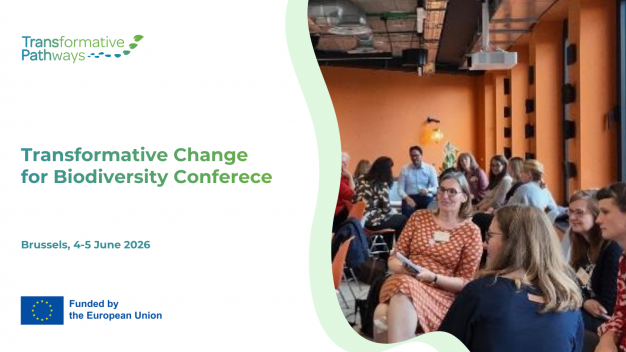
TRANSPATH closes four years of research with a third policy workshop at the EU Transformative Change Cluster Final Conference
Brussels, 4–5 June 2026
One month ago, nearly 150 researchers, policymakers, and practitioners gathered at Comet Louise in Brussels for the Transformative Change Cluster Final Conference. This milestone event was brought together by nine Transformative Change Horizon Europe projects to share years of research on what it actually takes to make biodiversity policy work in the real world. TRANSPATH was one of these projects.
Over the day-and-a-half of busy program days, seven TRANSPATH researchers presented findings spanning cocoa supply chains in Ghana, the biodiversity footprints of global shareholders, the relational values of nature, and the conditions that enable or block transformative change across Eastern and Western Europe. The breadth of that contribution reflects what the project has always argued: that transformative change requires simultaneous attention to structures, practices, and worldviews.
The centrepiece of TRANSPATH's presence was the third and final session of its Policy Workshop series, led by Zuzana Harmáčková and Pavlína Schultzová (Czech Globe). The workshop brought together approximately 15 participants to explore the implications of TRANSPATH's comparative European research for EU-level biodiversity policy. Using interactive Mentimeter polling, the session revealed an interesting and politically significant finding. Even in a room mostly made up of Western Europeans, participants often saw their own societies, especially in Eastern Europe, as more skeptical of transformative change than they actually are. At the same time, they viewed EU policies as being based on Western assumptions. State regulation was the only factor where East and West agreed. It was rated the highest of all factors tested and was seen as the most likely to work consistently across different European contexts.
The workshop's conclusions were direct. Well-intentioned regulation can backfire if it doesn't consider the conditions of those expected to follow it. Participation drops when people do not trust the government. The phrase "transformative change," although common in academic and policy circles, does not easily translate across the diverse societies and languages of Europe. A good example of this is how the word "community" is understood differently.
These findings, alongside contributions from WP1 on values and worldviews and WP4 on trade regulation and biodiversity financing, are now documented in Deliverable D5.8 Policy Workshop 3 Report, the final entry in TRANSPATH's policy engagement series. The report captures not only the workshop's discussions and policy recommendations, but the broader TRANSPATH contribution to the conference, and closes the loop with Deliverable D5.5, which in 2023 set out the plan for exactly this kind of joint final event.
The conference itself was the realisation of three years of cluster-wide collaboration, joint social media campaigns, working groups on values and justice, and a shared commitment to ensuring that the nine projects' findings reach policymakers, practitioners, and the public together, rather than in isolation. TRANSPATH's Pensoft Publishers stand in Track D, stocked with brochures, stickers, and project materials, was a small but visible symbol of that commitment throughout both days.
The project ends in October 2026, but the questions it has spent four years investigating are, if anything, more urgent now than when it began. The work continues.