Expanding impact: scale out, scale up, scale deep

Scaling positive experimentations (often referred to as “niches”) is considered a pathway to achieving large-scale transformative change. However, not all large-scale endeavors necessarily contribute to the change we aspire to: one where nature and humanity flourish through co-existence. In fact, scaling has sometimes led to the loss of the original purpose and, in some cases, even produced harmful social and environmental impacts.
This tool explores how scaling can be achieved while keeping transformative change at its core, and how to distinguish scaling from unlimited growth tendencies which have driven biodiversity loss and greenhouse gas emissions.
What you will achieve with this action?
Identify different scaling strategies to achieve systemic change
Get inspired by: La Via Campesina Movement

La Via Campesina (LVC) is a global movement advocating for food sovereignty and agroecology, and its European work illustrates how scaling strategies can drive systemic change. LVC scaled out by replicating farmer-led initiatives across diverse contexts, creating strong national and regional chapters while maintaining shared principles.
It scaled up by influencing European policy debates, embedding food sovereignty and agroecology into frameworks like the Common Agricultural Policy (CAP) through advocacy and coalition-building.
Simultaneously, LVC scaled deep by transforming cultural norms, promoting farmer-to-farmer learning, agroecology schools, and narratives that position food sovereignty as a human right. This combination of strategies safeguarded core values, built resilience, and challenged industrial agriculture paradigms. LVC’s approach shows that transformative scaling is not about growth alone but about institutional embedding, and cultural change working together.
Explore how to take action
Remember, this is an inspiration guide (not a recipe) to help you decide what will be most transformative for your context. Every context is unique!
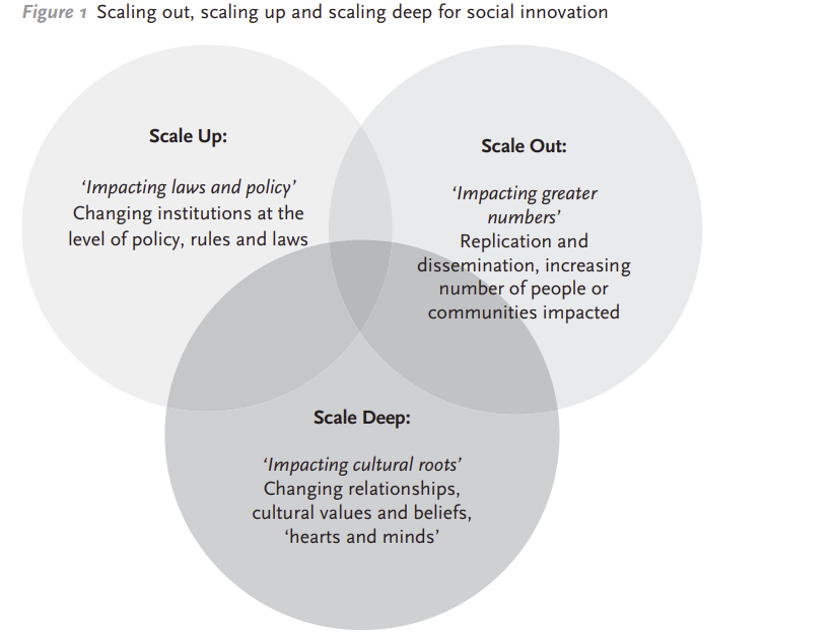 Figure 1: Moore et al. (2015)
With whom and for whom are you transforming?
How will you ensure that scaling does not dilute transformative intent?
What indicators will help you distinguish between scaling that deepens systemic change versus scaling that reinforces extractive growth patterns?
Scaling will inevitably challenge both you and the initiative you seek to advance, as it encounters established boundaries and structures. Transformative change does not necessarily mean expanding in numbers (scaling out). It can also involve scaling deep, by reinforcing shared values, strengthening social and nature connections within an existing initiative or group, improving practices, and embracing previously ignored or marginalized worldviews.
Additionally, it may require scaling up, by embedding innovations into policies and institutional frameworks.
Effective scaling connects these different modalities.
Transformative change is less about growth and more about building meaningful relationships and networks. It calls for positioning your initiative within a collaborative ecosystem of stakeholders and moving beyond marketable products or services toward strengthening networks that can sustain the journey toward systemic change.
References
Moore, M., Riddell, D., & Vocisano, D. (2015). Scaling out, scaling up, scaling deep: Strategies of Non-profits in Advancing Systemic Social Innovation. Journal of Corporate Citizenship, 2015(58), 67–84. https://doi.org/10.9774/gleaf.4700.2015.ju.00009