Reciprocal human-nature relationships

Major laws, policies, programs, or projects are built on principles, and those principles reflect how we think and act. If nature is not integrated into the way we work, live, and behave, the plans and projects we design will hardly embody what we preach. The practice described in this tool is intended to expand and reaffirm your interconnection with nature. It takes about 15 minutes, and we encourage you to do it regularly. By practising it, you will not only enhance your sense of well-being but also become more aware of the nature around you. Therefore, each time, you will gain a broader understanding of how to bring nature more frequently to the "decision-making room"
What you will achieve with this action?
Embracing yourself as part of nature and cultivating this awareness within your community.
Get inspired by: Pavel Cenkl from the Regenerative Learning Network
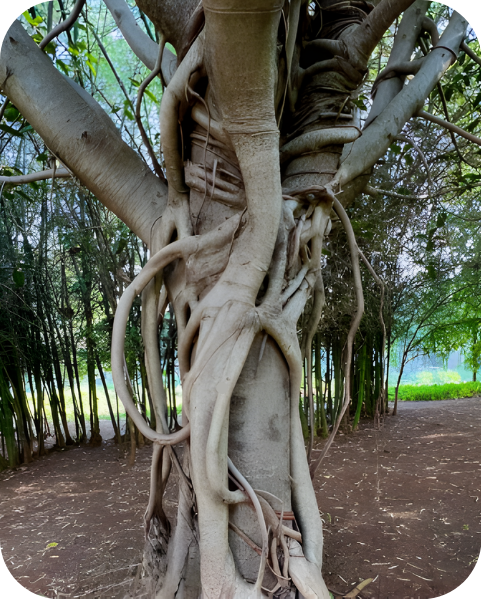
This image comes from Dr. Pavel Cenkl's personal archive during the Fourth International Conference on Regenerative Ecosystems at XIM University in Bhubaneswar. Beyond the time spent in auditoriums and meeting rooms listening, lecturing, or presenting, Pavel also took a moment to step aside and connect with the land he was visiting.
He visited The Farm, a regeneration project led by Poola Bhale, part of the larger Protecterra initiative. There, he had the opportunity to engage with the animals, ecosystems, and the intricate networks of the farm, as well as capture this photo of a banyan tree on Flame University’s campus.
Even during conferences—which are often packed and intense—taking a step outside is the first step toward reconnecting with nature and allowing its wisdom to inspire our understanding and work. Pavel is the founder of the Regenerative Learning Network.
Explore how to take action
Remember, this is an inspiration guide (not a recipe) to help you decide what will be most transformative for your context. Every context is unique!
With whom and for whom are you transforming?
How can you keep expanding your connection with nature?
Feeling connected to nature helps us develop a deeper sense of care and curiosity.
This curiosity invites us to understand nature through a more holistic perspective.
By nurturing our own connection to nature, we can inspire decisions that respect and strengthen this relationship,
and in this way contribute to a nature-positive future.
References
Coherence: regeneration and practice in India. (2025, December 17). Regenerative Learning Network. https://regenlearning.org/2025/12/08/coherence/
Trisos, C.H., Auerbach, J. & Katti, M. Decoloniality and anti-oppressive practices for a more ethical ecology. Nat Ecol Evol 5, 1205–1212 (2021). https://doi.org/10.1038/s41559-021-01460-w
Kimmerer, R. W. (2013). Braiding sweetgrass: Indigenous wisdom, scientific knowledge, and the teachings of plants. Milkweed Editions